
Challenges and Opportunities for Transformative Therapeutic Development for Ovarian Cancer
Forum Chairs
Forum Sponsored by

Forum Description
Ovarian cancer is one of the most aggressive cancers and a major cause of cancer morbidity and mortality in women. Poor outcomes relate, in part, to lack of adequate screening procedures, late stage at initial diagnosis, intrinsic or acquired drug resistance, and the propensity to disseminate widely intra-peritoneally. These traits render ovarian cancer one of the most challenging diseases to manage, with cytoreductive surgery and combination platinum-based chemotherapy having remained the mainstays of treatment. However, in the past few years, the completing of the TCGA analysis led to a new molecular classification of ovarian tumors and novel therapeutic strategies advanced to the forefront. Although there are now more than 280,000 ovarian cancer survivors in the United States, long-term survival in late-stage disease has improved little over the last four decades.
Important program Note
SPONSOR THIS FORUM
Sponsoring a Forbeck Forum is a powerful way to directly support groundbreaking cancer research by fostering collaboration among top scientists in the field. These intimate, focused meetings bring together leading researchers to share ideas, challenge assumptions, and spark innovative approaches that can accelerate progress toward cures. Your sponsorship helps cover the cost of hosting these unique gatherings, ensuring that vital conversations and partnerships continue to thrive. It's an investment in science, in collaboration, and ultimately, in better outcomes for patients.
Forum Summary
Ovarian cancer is the most lethal malignancy in gynecologic cancers. Although it is the 11th most common cancer in women, this cancer remains the 5th leading cause of death in women. Although most women respond initially to platinum-containing chemotherapy, 80% of women will relapse, become treatment resistance, and will die from this disease. These clinical outcomes led to the main theme of the Forbeck Forum “Challenges and Opportunities for Transformative Therapeutic Development for Ovarian Cancer” on March 11-12, 2022. At this forum, transformative ways to target treatment resistance to PARPi resistance, immunotherapy, and chemotherapy (carboplatin, cisplatin, gemcitabine, and paclitaxel) were presented by known leaders in the field with the ultimate goal of improving outcomes of ovarian cancer patients.
To address resistance, we discussed key potential targets including:
- enhancing the immune system through a specific pathway called cGAS-STING (i.e., “innate” immunity) to recognize and eradicate ovarian tumor cells
- epigenetics (not genetics), including DNA methylation and proteins that package DNA called histones, and bringing new epigenetic therapies into the ovarian cancer (OC) clinic
- targeting chemotherapy-induced cancer stem cells (CSCs), the small population of highly drug resistant cells that survive after chemotherapy, and ways to prevent enrichment of OCSCs
- employing immunotherapy combined with other therapeutics, including PARP inhibitors (PARPi) and epigenetic drugs (to “prime” the immune system), and the potential of starting these therapeutic approaches earlier during the course of OC treatment
- inhibiting DNA methylation to reduce evasion of OC cells by the immune system, using DNA methylation inhibitors to activate otherwise “repressed” elements that can cause immune signaling and enhance the innate immune system against ovarian tumor cells
- specific targets on the surface of OC cells (membrane receptors) and new drugs for these targets
- identifying how the origin of OC (ovarian surface epithelium vs fallopian tube epithelium cancer) may inform development of therapies
- biomarkers for response to PARPi, mechanisms underlying resistance and overcoming resistance to PARPi and new clinical trials designed to expand the use of PARPi
- novel mouse models that harbor common genetic changes found in human OC
- therapeutic vulnerabilities based on metabolism of OC cells and the tumor microenvironment
This forum was unique with the expertise of the participants in epigenetics, DNA repair, immunology, pathology, CRISPR (gene editing) technology, transposable elements and senescence. Additional expertise included basic scientists, translational scientists, mouse model system experts, and clinical trialists. This expertise led to robust and significant cross-expertise discussions such as how targeting epigenetics can affect the immune response that can then lead to smarter, more informative clinical trial design.
Outcomes: Future projects and collaborations include the following:
- How to identify response to immunotherapy through tertiary lymphoid structures (TLS) to correlate with improved survival
- How aging mouse models can be used to study tumor progression and the impact on the immune response
- How artificial intelligence may improve diagnosis and pathological changes in OC
- Sharing animal models of ovarian cancer between participants
- Sharing ovarian cancer tissue resources between participants (tissue microarrays)
- Sharing rare type cancer cell lines between participants
- Collaborations for multi-institutional clinical trials and grant applications have been discussed among participants
- Sharing genomic databases for exploration of research questions previously not addressed between participants
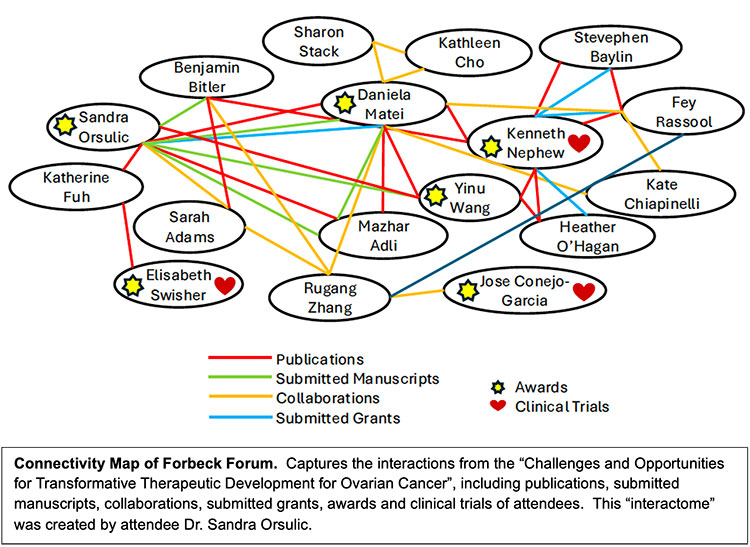
In summary, this forum has formed scientific and professional collaborations that will continue and will result in impactful papers, grants, and clinical trials.
Additional Updates – April 6, 2026
How has our field changed since the Forum?
- Single-cell resolution technologies and digital spatial technologies that interrogate spatial biology, transcriptomics, metabolomics,and proteomics has provided a comprehensive understanding of the tumor microenvironment.
- The first comprehensive pre-cancer atlas of fallopian tube precursors to high grade serous ovarian cancer is published (cbioportal data set available; PMID: 39704522).
- Since the Forbeck seminar, there has been a slow but significant shift in the therapeutics. Specifically, a contraction of PARP inhibitor use and expansion of antibody driven approaches (antibody-drug conjugates) or cellular therapies (CAR T, CAR NK). Moreover, with the technology advancements the therapeutically targeting non-tumor cell compartment has come into focus.For instance, macrophages are supporting not only disease progression, but also reinforce immune suppression, thus strategies to “re-program” macrophages continue to gain traction in the pre-clinical space.
- New targeted therapy: FDA approved ADC mirvetuximab soravtansinefor platinum-resistant ovarian cancer.
Manuscripts Under Review (Forbeck Forum collaborators are in bold)
- Ana Maria Isac, Andres Valdivia, Yinu Wang, Guangyuan Zhao, Chinmayee Prabhu Dessai, Ujin Kim, Sandra Orsulic, Ji-Xin Cheng, and Daniela Matei FABP4 Mediated Fatty Acid Transport Promotes Proliferation of Platinum-Resistant Ovarian Cancer Cells. Under review
- Elizabeth R Woodruff, Courtney A Bailey, Francis To, Vyshnavi Manda,Joanne K Maltzahn, Timothy M Sullivan, Meher P Boorgula, Maria Sol Recouvreux, Ruby Vianzon, Bogi Conrad, Kathleen M Gavin, Kimberly R Jordan, Dwight J Klemm, Sandra Orsulic, Benjamin G Bitler, Zachary L Watson. Ablation of hematopoietic stem cell derived adipocytes reduces tumor burden in syngeneic mouse models of high-grade serous carcinoma. Under review
Awards and Achievements
- Kenneth Nephew named Dean of the Ovarian Cancer Academy
- Sarah Adams named Dean of Ovarian Cancer Clinical Trial Academy
- Ben Bitler is involved in a SPORE team and is a co-investigator on an OCRA Health Equity Grant
- Yinu Wang received Early Career Investigator Award from OCRA
- Sandra Orsulic and Daniela Matei received a Collaborative VA Merit Grant to study platinum resistance in ovarian cancer
- Jose Conejo-Garcia received a DoD grant for the idea he presented at the Forbeck meeting - to investigate the formation of tertiary lymphoid structures in ovarian cancer, and clone antibodies as well as TCRs from histological sections with evidence of TLS
- Elisabeth Swisher has had multiple new appointments: Co-deputy Director of Fred Hutch/UW/Seattle Children’s Cancer Consortium; Elected to AAP; CurrentChair-elect of the AACR Cancer Prevention Working Group; Co-Chair of OvarianAACR meeting, 2023 and 2025
What results have come from this Forum?
Jose-Conejo Garcia: We have also made progress on the clinical trial for patients with recurrent, chemo resistant ovarian cancer that I presented at the meeting, who are being treated with FSHR-targeted CAR T cells IP. Nine patients have been treated and 2 of them have experienced significant clinical responses. One of them was injected with a second infusion of CART > a year after the initial remission.
Elizabeth Swisher: Completed enrollment on this IIT: NCT04673448 - Niraparib and TSR-042 for the Treatment of BRCA-Mutated Unresectable or Metastatic Breast, Pancreas, Ovary,Fallopian Tube, or Primary Peritoneal Cancer.
Memories & Stories
Mazhar Adli: It was indeed one of the most useful and productive meetings I have attended. We have had multiple collaborative papers based on the ideas we discussed at that meeting. For example, during coffee and lunch break discussions with Prof. Orsulic, we decided to collaborate and utilize her tissue microarrays (TMAs). This collaboration resulted in co-authorships in two impactful paper (above). Similarly, Daniela and I have published several papers together since that meeting (above).
Benjamin Bittler: I look back on this meeting with fond memories! First meeting in the midst of COVID, this meeting represented an incredible opportunity to reconnect with friends and develop new collaborations. I appreciated the forward thinking that the meeting afforded, using the breadth of existing ovarian cancer research we had the privilege of looking toward the next big discovery.
Jose Conejo-Garcia: I have a great memory of that meeting.
Daniela Matei: I also started many collaborations that continue to this day. Collaborating with Sandra Orsulic and used resources and cell lines she generated. Sandra helped me with a R01 grant that has been reviewed and revised a couple of times—it is still under review; she is aco-I on this grant. We also used tumors from Ken’s group, for a collaborative project that resulted in a paper about disparities in ovarian cancer. I am yet to get Kathy Cho’s mice, but it is on my list. I did get cell lines from Rugang Zhang for some experiments. Kate Chiapinelli provided advice on computational analysis for ERVs on a study. I also have collaborated with Sharon Stack and she has provided me with critical professional advice and mentoring, when I needed it. Yinu Wang received Early Career Investigator Award from OCRA.
Ken Nephew: My first in person conference post-pandemic and a great way to "ease back into research life” after Covid. I remember getting tested the first night of the conference! Fond memories of dining together (big round tables), talking science and laughing together! Collaborations fostered during the Forum resulted on co-authored publications with Daniela, Yinu, Heather, Fey, Steve and Ben; Paired platinum resistant HGS OC cell lines models from Daniela; Hosted Kathy Cho for Grand Rounds at IUSCCC; Collaborative projects with Heather-New Co-PI awards from the Ovarian Cancer Alliance of Greater Cincinnati, submitted MPI R01 (will resubmit this year); Fey- submitted MPI R01 grant- A1 to be submitted this year; Steve and Fey- will submit SPORE renewal application this year- Fey & I Co-Lead OC Project in "Epigenetic Therapies New Advances" SPORE; Steve is the overall SPORE Co-PI and also Co-leads a project. Rugang was Keynote Speaker at the Ovarian Cancer Academy Workshop- side note- Rugang first suggested that Daniela and I apply to Forbeck. I was named Dean of the Ovarian Cancer Academy (Ronny Drapkin is Assistant Dean)and we received renewal this year (four more years) & Sarah named Dean of Ovarian Cancer Clinical Trial Academy: Future Deans of OCA and OCCTA attended the same Forbeck Forum- odds of that?!!
Sandra Orsulic: That was quite a conference! It felt like a family gathering where I was meeting long-lost cousins for the first time — familiar yet new, and truly inspiring. If the forum set out to unite bright minds with common interests in cancer, it absolutely delivered!
Fey Rassool: I was relatively new to the ovarian cancer field and had a key opportunity to meet and interact with some of the luminaries in the ovarian cancer field. In particular, interactions with Rugang Zhang and Kate Chiapinelli definitely led to publication of a stronger paper in ovarian cancer. Key to publishing our paper was also connecting with Daniela Matei, who helped us reexamine her RNA seq data from a recent clinical trial in ovarian cancer. Finally, my talk on STING in ovarian cancer subtypes at the Forbeck has also led to collaboration with Ken Nephew on STING agonists in this disease.
Sharon Stack: That was a great meeting! What I talked about at the meeting is now published. In a follow-up that we're preparing to submit, targeting SREBP1 in combo with SOC therapy delays recurrence in high fat diet mice. Daniela has given our group lots of advice on dosing strategies for our murine experiments, both carbopt/paclitaxel and olaparib. Several good conversations with Steve Baylin on all things scientific. Also still thinking about Kathy Cho's mice (and actually just emailed her about them last week!) as soon as I can find some funding!
Rugang Zhang: It was indeed a very memorable meeting, and I learnt so much from everyone. I have ongoing collaborations with Ben Bitler, Jose Conejo-Garcia and Sara Adams. The concept of targeting epigenetic regulators to overcome therapy-resistance presented in the meeting resulted in a project in MD Anderson ovarian cancer SPORE.
Liz Swisher: I have had a lot of conversations about Kathy’s mice and sent several young investigators her ways for collaboration. And she was recently our keynote speaker for annual UW WRHR retreat. Many collaborative publications and accomplishments (above).
Venue & Travel Information
800 Asilomar Avenue
Pacific Grove, CA 93950
CONFIRM YOUR ATTENDANCE
The Forbeck Forum is an exclusive, invite-only venue designed for open discussion, knowledge sharing, and collaboration. Limited to just 15-20 participants, this intimate gathering brings together the world’s leading oncology experts to exchange insights and drive innovation in the field.
If you’ve received this invitation, you’ve been recognized as one of the foremost leaders in oncology. Please confirm your attendance by clicking the button below and completing the confirmation form.
We look forward to your participation in this impactful and inspiring event!
Travel Forms
Please familiarize yourself with our travel policy below before booking your travel. If you have any questions about our policy, please do not hesitate to contact us for clarification.
Travel forms are due 30 days prior to the start of the forum to allow enough time to plan transportation.
To help reduce transportation costs, the Foundation tries to group travelers on shuttle vans rather than providing transportation for single travelers. The times below are not exclusive but represent times that we hope to have shuttles leave the airport.
The Monterey Regional Airport (MRY) is the preferred airport as it is only 20 minutes from the venue.
- Arrival day of the forum at approximately 1:00 PM, 3:00 PM and 5:00 PM
- Departures from the venue at approximately 8:00 AM, 10:00 AM, and 12:00 PM
San Francisco International Airport (SFO) is 2 hours from the venue without traffic. The Foundation tries to prioritize International Flights and situations where flying into SFO is significantly cheaper than connecting to MRY. The times below are for guidance only, and depending on the volume of travelers, we may add an additional shuttle to and from the airport.
- Arrival day of the forum at approximately 3:00 PM
- Departures from the venue at approximately 10:00 AM
IMPORTANT INFORMATION ABOUT GROUND TRANSPORTATION
To maximize funding for our Forums, the Foundation does not reimburse ground transportation costs outside the designated shuttle pick-up times. If you arrive after the final shuttle, or do not wish to wait for or take a scheduled shuttle, you will be responsible for arranging and covering your own transportation to the Forum venue.
Travel Policy & General Information
Travel Policy
Please familiarize yourself with our policies and procedures for travel. We truly appreciate you taking the time to participate in this meeting. As you make your plans please remember that we are a nonprofit organization dependent on donations and volunteers. So please note what we do and do not cover.
What the Foundation Pays For
- ACCOMMODATIONS for the nights of the Forum only. People traveling from overseas or far away may arrive 1 night early to adjust for jet lag or to navigate longer travel times.
- MEALS are provided by the foundation during the forum.
- A TRAVEL ALLOWANCE FOR AIRFARE will be set based on an economy ticket from your home airport. If you have travel before or after that is fine. We do not increase the allowance for other travel plans.
- The Foundation provides SHUTTLES TO/FROM THE AIRPORT to the meeting venue at designated shuttle times.
- You can select not to utilize Foundation arranged transportation at your own expense when completing the travel form.
What the Foundation does not cover
- We do not cover upgrades of any kind.
- Travel Allowance will not be increased due to late booking or changes.
- We do not cover incidental costs during your travel. So please do not send your food receipts.
- We do not cover additional nights at the venue outside of the meeting dates.
- We do not cover transportation outside of the designated shuttle times.
- We do not reimburse for home side airport transfer (to/from your home/office to your airport).
Important Things to Note
- Everyone must fill out the travel form!
- We must have your itinerary and travel receipt to receive reimbursement.
- If we do not have your reimbursement information within 3 months after the Forum, reimbursement will not be issued.
- Flights must be booked at least 30 days prior to the meeting or you may not have accommodations and airport transfer.
- We often use volunteers for airport transfers.
- The travel confirmation will be sent out the WEEK before your Forum.
- The speaking agenda will be sent out the NIGHT before your Forum.
- We expect participants to attend ALL sessions.
Frequently Asked Questions
- Travel Confirmation will be sent out within 1 week of the meeting. This will include a hotel confirmation number, if there is one, airport transfer details. We have to wait until we receive almost everyone’s travel to book airport transfer. Also due to frequent airline changes we wait until the week of the meeting to send this out.
- Speaker agenda is not sent out prior to the meeting. It will be provided upon arrival in the meeting packet. We do not tell people when they are speaking because we expect everyone to attend all sessions. Sessions are all day Friday and Saturday.
- Frequently airport transfer is provided by volunteers. Please be patient on receiving this information. Airport transfer will be sent out prior to arrival.
Abstracts
Abstracts are due 30 days prior to the start of the meeting to allow enough time to prepare the meeting book.
The abstracts should be only one or two paragraphs outlining the theme of your presentation and should reflect the objective and spirit of the meeting (see above). Abstracts will be circulated about one week before the meeting. The meeting organizer will start requesting them a month before the meeting.
Forum Structure
The structure of the forum has been developed over years of experience.
- Participants have approximately 45 minutes, depending on the number of participants, for their presentation and discussion. The presentation is meant as a conversation start and should last about twenty minutes briefly covering background information and areas that are new or need further input. This should be structured in such a way as to lead to a lively discussion. Participants are encouraged to interrupt to ask questions or start discussions.
- Each presentation is limited to 2 slide equivalents. Slides should include no more than one graph or gel per slide and a maximum of 5 bullet points. Avoid animations or motion effects. Slides should support discussion, not serve as a script. Thank you for adhering to the spirit of this format.
- A Whiteboard and markers will be available to supplement your digital slides.
- Everyone is expected to actively participate in every session and discussions.
- The time spent at the forum is relatively short, so please be familiar with papers received prior to arrival.
- It is very important that you commit to all sessions of the 2 days of the forum.
Forbeck Scholars Participation
Scholars are selected for each Forbeck Forum. These are outstanding junior clinical or post-doctoral fellows selected based on the quality and relevance of science.
- Scholars present for 30-45 minutes, depending on the number of participants
- The same presentation rules apply for scholars
- After the Forum you are selected to attend, you will attend three years of Scholar Retreats held in Lake Geneva, WI. If you attend a Fall Forum, you will attend the Spring Retreat. If you attend a Spring Forum you will attend a Fall Retreat.
- Scholars are selected by the Foundation Scientific Advisory Board and peer reviewers selected from past Forbeck Scholars.
Program
The schedule below outlines the official program for this forum. A detailed agenda, including individual speaking times, will be provided on the first day of the event.
Frequently Asked Questions
Below are some of our most Frequently Asked Questions. If you have something new to ask, please feel free to contact us.
- Travel Confirmation will be sent out within 1 week of the forum. This will include a hotel confirmation number, if there is one, and airport transfer details. We have to wait until we receive almost everyone’s travel to book airport transfer. Due to frequent airline changes, we wait until the week of the meeting to send this out.
- Airport transfer is provided by Foundation staff, volunteers or arranged shuttle at specific times. If you opt to utilize Foundation airport transportation on your travel form, please be patient in receiving this information. We will send it the week of the forum.
- Speaker agenda is not sent out prior to the meeting. It will be provided upon arrival in the meeting packet. We do not tell people when they are speaking because we expect everyone to attend all sessions. Sessions are all day.
- Frequently airport transfer is provided by volunteers. Please be patient on receiving this information. Airport transfer will be sent out prior to arrival.
- REMINDER: We do not reimburse for home side airport transfer or incidentals while traveling. We will not honor miscellaneous receipts sent for these expenses.
Forum Participants
Forum Scholars
Photos
PODCAST